A fellow ponderer got me thinking about time the other day.
He was referring to all of the additional time that it now takes people to get through airport security, and how this is being done solely in the name of saving lives. The question then, was how many millions of additional hours has this now totaled the American people, and how many “man-lives” does it equal to?
That’s kind of an abstract concept. After all, even if hundreds or even thousands of additional “man-lives” have been “lost” at airport security, each individual passenger has only lost a few of those hours themselves. For most of us, if a concept doesn’t affect us personally, we either have a hard time grasping it or it simply doesn’t matter to us all.
Five years ago I left Orlando, FL and moved to a tiny little town called Liberty, KY. The change was dramatic; a population of half a million people to less than 2,000, a 6-figure paycheck to hovering around the poverty line, and, for this example, a 45 minute commute traded in for (quite literally) a drive of less than 2 minutes.
I should clarify to say that my 45 minute commute was one-way; I spent fully 1-1/2 hours in my car every day, 5 days a week, just going to and from work. By comparison, the 4 minutes I spend now isn’t even worth mentioning.
It was this 1-1/2 hours that I no longer spend each day that I started to think about in earnest. 90 minutes a day doesn’t necessarily sound like a lot until you consider that it equals over 16 days each year.
Think about that! I used to spend 16 days each year just sitting in my car.
Usually frustrated.
Usually stuck in traffic or sitting at a stoplight.
Talk about a waste of time!
To take it further, what that means is that in just the past 5 years I have gained almost 3 entire months of time – 3 entire months of my life – that I was able to use for anything I wanted!
How many times have you heard someone lament that they wish they could have had “just one more day” with a loved one? How would they react if they learned that they could have had days, weeks, months – even years – simply by getting rid of one or two of those things that we waste our time on every day?
Each of us has a finite amount of time on this earth, and yet so often we spend it without even thinking about it, as if there was an unlimited supply.
There’s not.
And the cruel twist is that none of us even knows how much time we have left on our own personal lunch ticket. In light of that, how could we ever waste it as if it means nothing?
To look at it from another perspective, if we could buy time, how much would we pay to get an additional 16 days of life each year? For that matter, what is a single day worth in monetary terms?
I would imagine that if you needed one bad enough, it would be priceless.
Tuesday, September 21, 2010


Monday, August 23, 2010
Money for Nothing
For various reasons - not the least of which is that they wanted to try it out - we decided to put our remaining two children in a local Christian Academy this year.
We’ve homeschooled since 2001, and we don’t subject our children to vaccines. People might say that’s not good parenting, but our kids aren’t plagued by the issues that affect so many other children these days so I would argue otherwise.
Our kids are healthy and have strong immune systems. They are not overweight, have no medical conditions, and take no prescriptions. They are like children used to be when I was growing up.
To enroll them in school, however, we needed to either get them caught up on their vaccinations or request a waiver from the health department. (The only way you can bypass vaccinations is with a “religious” exemption, even if it has nothing to do with your religious beliefs).
So I went to the health department, wrote out the statements for each child, and then had to wait 30 minutes to have a “state mandated counseling session”, which amounted to a nurse telling me for 3 minutes what a good idea it is to have my kids vaccinated. This undoubtedly has a high success rate for 19 year old mothers who are too shy to say “no”, but it doesn’t have much affect on a grizzled old cynic like me.
But okay. I’ll jump through the hoops. Dot the “i’s” and cross the “t’s”. So I did.
They charged me $48. Twenty-four for each kid, neither of which was even there.
How’s that for a deal? It cost fifty bucks to not have anything done. Is it just me, or is it a strange world we live in when we not only have to pay to get something, but we also have to pay to not get it.
The funny thing, though? I would bet that there is some state program that would have allowed me to have each child fully vaccinated at no absolutely no charge.
Go figure.
We’ve homeschooled since 2001, and we don’t subject our children to vaccines. People might say that’s not good parenting, but our kids aren’t plagued by the issues that affect so many other children these days so I would argue otherwise.
Our kids are healthy and have strong immune systems. They are not overweight, have no medical conditions, and take no prescriptions. They are like children used to be when I was growing up.
To enroll them in school, however, we needed to either get them caught up on their vaccinations or request a waiver from the health department. (The only way you can bypass vaccinations is with a “religious” exemption, even if it has nothing to do with your religious beliefs).
So I went to the health department, wrote out the statements for each child, and then had to wait 30 minutes to have a “state mandated counseling session”, which amounted to a nurse telling me for 3 minutes what a good idea it is to have my kids vaccinated. This undoubtedly has a high success rate for 19 year old mothers who are too shy to say “no”, but it doesn’t have much affect on a grizzled old cynic like me.
But okay. I’ll jump through the hoops. Dot the “i’s” and cross the “t’s”. So I did.
They charged me $48. Twenty-four for each kid, neither of which was even there.
How’s that for a deal? It cost fifty bucks to not have anything done. Is it just me, or is it a strange world we live in when we not only have to pay to get something, but we also have to pay to not get it.
The funny thing, though? I would bet that there is some state program that would have allowed me to have each child fully vaccinated at no absolutely no charge.
Go figure.
Thursday, April 1, 2010
Moby Dick - Smash or Trash?
I enjoy reading classic literature and have finally gotten around to Moby Dick. It’s taking awhile to read, partly because I have to concentrate harder to comprehend the style of English used at the time of its writing, and partly just because it’s a very long book in its own right.
Moby Dick is, without a doubt, a classic piece of literature. But, 159 years after its original publication, I have to wonder how well Herman Melville’s story would be received had he written it today.
My honest guess? He would not even be able to get it published. Certainly, at least, not without massive amounts of editing.
As a case in point, consider the below passage taken from Chapter 42. It’s just one piece of a much longer explanation that Ishmael is giving about the color white; how, while it is usually associated with cleanliness, good, purity, etc., it can also have a much more sinister and ominuos connotation (such as the pale white of death):
From Moby Dick, Chapter 42 – “The Whiteness of the Whale”:
“Though in many natural objects, whiteness refiningly enhances beauty, as if imparting some special virtue of its own, as in marbles, japonicas, and pearls; and though various nations have in some way recognised a certain royal preeminence in this hue; even the barbaric, grand old kings of Pegu placing the title "Lord of the White Elephants" above all their other magniloquent ascriptions of dominion; and the modern kings of Siam unfurling the same snow-white quadruped in the royal standard; and the Hanoverian flag bearing the one figure of a snow-white charger; and the great Austrian Empire, Caesarian, heir to overlording Rome, having for the imperial color the same imperial hue; and though this pre-eminence in it applies to the human race itself, giving the white man ideal mastership over every dusky tribe; and though, besides, all this, whiteness has been even made significant of gladness, for among the Romans a white stone marked a joyful day; and though in other mortal sympathies and symbolizings, this same hue is made the emblem of many touching, noble things- the innocence of brides, the benignity of age; though among the Red Men of America the giving of the white belt of wampum was the deepest pledge of honor; though in many climes, whiteness typifies the majesty of Justice in the ermine of the Judge, and contributes to the daily state of kings and queens drawn by milk-white steeds; though even in the higher mysteries of the most august religions it has been made the symbol of the divine spotlessness and power; by the Persian fire worshippers, the white forked flame being held the holiest on the altar; and in the Greek mythologies, Great Jove himself being made incarnate in a snow-white bull; and though to the noble Iroquois, the midwinter sacrifice of the sacred White Dog was by far the holiest festival of their theology, that spotless, faithful creature being held the purest envoy they could send to the Great Spirit with the annual tidings of their own fidelity; and though directly from the Latin word for white, all Christian priests derive the name of one part of their sacred vesture, the alb or tunic, worn beneath the cassock; and though among the holy pomps of the Romish faith, white is specially employed in the celebration of the Passion of our Lord; though in the Vision of St. John, white robes are given to the redeemed, and the four-and-twenty elders stand clothed in white before the great-white throne, and the Holy One that sitteth there white like wool; yet for all these accumulated associations, with whatever is sweet, and honorable, and sublime, there yet lurks an elusive something in the innermost idea of this hue, which strikes more of panic to the soul than that redness which affrights in blood.”
Wow.
Other than the obvious changes in grammar & language that make it almost incomprehensible to today’s reading public, two things drew my attention to this particular passage.
For one, it is a single sentence, 467 words long. Do you think you could have gotten away with that had you turned it in to your English teacher in high school? That single sentence is 1/3 the length of my entire senior term paper!
Secondly, did you notice the whopper of a politically incorrect statement buried inside the text: “and though this pre-eminence in it applies to the human race itself, giving the white man ideal mastership over every dusky tribe”.
Whoa, Nellie! That dog ain’t gonna be hunting in 2010, now is it? In fact, “classic” though Moby Dick may be, I wouldn’t be at all surprised if that particular statement didn’t one day make a quiet exit from the text entirely. (And maybe more telling is that I doubt anyone today would even notice if it did.)
Anyone who has ever attempted to put pen to paper with the intention of forming a novel can truly appreciate - and stand in awe - of the sheer craftsmanship that was required to carve out the 500 pages of Moby Dick. In today's world unfortunately, that, plus $1.50, will get you a cup of coffee at McDonald's.
Dear Mr. Melville,
I regret to inform you that your manuscript “Moby Dick” does not fit our needs at this time. The book is so endlessly complicated by details and reference information that the very action of the story becomes hopelessly bogged down, making the book, eventually, unreadable. It is so dry, airless, and lacking in pace, that whatever drama and excitement the novel might have contained is entirely dissipated by what seems to be nothing more than an immense amount of extraneous material.
Yours sincerely,
21st Century Editor
Moby Dick is, without a doubt, a classic piece of literature. But, 159 years after its original publication, I have to wonder how well Herman Melville’s story would be received had he written it today.
My honest guess? He would not even be able to get it published. Certainly, at least, not without massive amounts of editing.
As a case in point, consider the below passage taken from Chapter 42. It’s just one piece of a much longer explanation that Ishmael is giving about the color white; how, while it is usually associated with cleanliness, good, purity, etc., it can also have a much more sinister and ominuos connotation (such as the pale white of death):
From Moby Dick, Chapter 42 – “The Whiteness of the Whale”:
“Though in many natural objects, whiteness refiningly enhances beauty, as if imparting some special virtue of its own, as in marbles, japonicas, and pearls; and though various nations have in some way recognised a certain royal preeminence in this hue; even the barbaric, grand old kings of Pegu placing the title "Lord of the White Elephants" above all their other magniloquent ascriptions of dominion; and the modern kings of Siam unfurling the same snow-white quadruped in the royal standard; and the Hanoverian flag bearing the one figure of a snow-white charger; and the great Austrian Empire, Caesarian, heir to overlording Rome, having for the imperial color the same imperial hue; and though this pre-eminence in it applies to the human race itself, giving the white man ideal mastership over every dusky tribe; and though, besides, all this, whiteness has been even made significant of gladness, for among the Romans a white stone marked a joyful day; and though in other mortal sympathies and symbolizings, this same hue is made the emblem of many touching, noble things- the innocence of brides, the benignity of age; though among the Red Men of America the giving of the white belt of wampum was the deepest pledge of honor; though in many climes, whiteness typifies the majesty of Justice in the ermine of the Judge, and contributes to the daily state of kings and queens drawn by milk-white steeds; though even in the higher mysteries of the most august religions it has been made the symbol of the divine spotlessness and power; by the Persian fire worshippers, the white forked flame being held the holiest on the altar; and in the Greek mythologies, Great Jove himself being made incarnate in a snow-white bull; and though to the noble Iroquois, the midwinter sacrifice of the sacred White Dog was by far the holiest festival of their theology, that spotless, faithful creature being held the purest envoy they could send to the Great Spirit with the annual tidings of their own fidelity; and though directly from the Latin word for white, all Christian priests derive the name of one part of their sacred vesture, the alb or tunic, worn beneath the cassock; and though among the holy pomps of the Romish faith, white is specially employed in the celebration of the Passion of our Lord; though in the Vision of St. John, white robes are given to the redeemed, and the four-and-twenty elders stand clothed in white before the great-white throne, and the Holy One that sitteth there white like wool; yet for all these accumulated associations, with whatever is sweet, and honorable, and sublime, there yet lurks an elusive something in the innermost idea of this hue, which strikes more of panic to the soul than that redness which affrights in blood.”
Wow.
Other than the obvious changes in grammar & language that make it almost incomprehensible to today’s reading public, two things drew my attention to this particular passage.
For one, it is a single sentence, 467 words long. Do you think you could have gotten away with that had you turned it in to your English teacher in high school? That single sentence is 1/3 the length of my entire senior term paper!
Secondly, did you notice the whopper of a politically incorrect statement buried inside the text: “and though this pre-eminence in it applies to the human race itself, giving the white man ideal mastership over every dusky tribe”.
Whoa, Nellie! That dog ain’t gonna be hunting in 2010, now is it? In fact, “classic” though Moby Dick may be, I wouldn’t be at all surprised if that particular statement didn’t one day make a quiet exit from the text entirely. (And maybe more telling is that I doubt anyone today would even notice if it did.)
Anyone who has ever attempted to put pen to paper with the intention of forming a novel can truly appreciate - and stand in awe - of the sheer craftsmanship that was required to carve out the 500 pages of Moby Dick. In today's world unfortunately, that, plus $1.50, will get you a cup of coffee at McDonald's.
Dear Mr. Melville,
I regret to inform you that your manuscript “Moby Dick” does not fit our needs at this time. The book is so endlessly complicated by details and reference information that the very action of the story becomes hopelessly bogged down, making the book, eventually, unreadable. It is so dry, airless, and lacking in pace, that whatever drama and excitement the novel might have contained is entirely dissipated by what seems to be nothing more than an immense amount of extraneous material.
Yours sincerely,
21st Century Editor
Tuesday, March 30, 2010
Why I Believe in God: Part III - The Church of Evolution
(to start at the beginning of this series, click here)
If there is one single overriding factor that gives evolution presumed validity over creation, it is that evolution is based on science, whereas creation is based on superstition and ignorance.
In ancient times, it is supposed that people didn’t understand the things that happened in the world around them. They knew that things did happen, and they also knew that they were not the ones that caused those things to happen, and so they assumed that someone or something had put those events into motion. They called these unseen – and obviously very powerful – things “gods”.
Science, on the other hand, establishes fact based on cause & effect, not wild speculation. Science is non-judgmental. It is unbiased. It is rational. It seeks the truth.
“Creation” says that the earth, stars, mankind – everything – was created by an unseen entity of incomprehensible power. “Evolution” says that it all came about through natural causes, random chance, and progressive evolutionary growth. Religion is based on wishful thinking; Science, on the other hand, is based on fact.
It certainly sounds like evolution – backed with the authority of science – has a legitimate argument. Until you realize that science doesn’t really have any facts at all, and evolution is, like Christianity, Buddhism, Islam, etc., merely another religion.
How could I believe that?
Well, start with the concept of evolution, or more to the point, the theory of evolution, because despite all of the pomp & circumstance, that’s really all that it remains – a theory.
While evolution is “widely believed to be true” by the scientific community, it has not been proven by any stretch of the imagination. If it had been, you can bet the very first thing scientists would have done would be to trumpet that particular fact to the world.
But they haven’t. All they have done is to simply stop referring to evolution as a theory and forge ahead under the assumption that it is true.
Personally, I have never been presented with any “proof” of evolution, only a “preponderance of evidence”. The problem with that is that there is also a “preponderance of evidence” for the existence of God – a creator – as well, though, like evolution, there is no “proof’ of God either.
People believe in God by faith, and faith, by definition, is belief without proof. That poses a big problem for evolutionists, because evolution is based on science, and science is supposed to be based on fact, not speculation. But regarding evolution, there are no facts and there is no proof, and without those, evolution is just as surely a faith-based religion as any other.
Make no mistake about it, evolution is a religion. It all boils down to which church you choose to enter; the church of God, or the church of man.
In fact, the only thing that even remotely resembles “proof” of evolution seems to be time, or more specifically, the dating of fossils and artifacts.
Looking at the Biblical record, there certainly appears to be roughly 6,000 years from the time of Adam to the present date. Scientists, through several different means, have dated things back millions of years. How to account for the huge discrepancy?
Some people fault the methods that scientists use to date objects, saying that they are loaded with assumptions (which they are) and that their results cannot be validated (which they can’t). But though there may be some anomalies with the various different dating methods used, I have no doubt that they are essentially correct. Even if they are not 100% exact, I would have to guess that they are at least “in the ballpark”.
The “time” issue is without a doubt a massive hole in the argument for creation. It’s a huge disparity, and it is that disparity – from all that I see and hear and read – that seems to be the one single horse upon which almost all information about evolution is riding. If there was ever anything at all that provides legitimacy to the theory of evolution, “time” would have to be it.
But what if “time” was not an issue? What if there was no disparity? If “time” were taken out of the equation entirely, is there anything left that would truly lend any sort of factual, scientific validation to evolution?
Those were some of the questions that I asked myself, and once I started looking at time as a separate entity, I realized that there could actually be a very plausible explanation to account for it. Not proof mind you, but certainly something that I think casts plenty of “reasonable doubt” on the issue.
If you’re following my train of thought, I’ll need you to humor me at this point and suspend your belief about the disparity of “time” as I did; I’ll address it at a later date. And please remember, I’m not trying to convince you of anything; I’m only trying to share how I came to believe that God is real. You can believe whatever you want. You will anyway.
But if you have followed me to this point, let me summarize where I found myself:
1) There either is a God or there isn’t, and I either believe in Him or I don’t.
2) Evolution is just as much of a religion as Christianity.
Once I truly understood what I was dealing with, I was finally able to get down to some real searching.
If there is one single overriding factor that gives evolution presumed validity over creation, it is that evolution is based on science, whereas creation is based on superstition and ignorance.
In ancient times, it is supposed that people didn’t understand the things that happened in the world around them. They knew that things did happen, and they also knew that they were not the ones that caused those things to happen, and so they assumed that someone or something had put those events into motion. They called these unseen – and obviously very powerful – things “gods”.
Science, on the other hand, establishes fact based on cause & effect, not wild speculation. Science is non-judgmental. It is unbiased. It is rational. It seeks the truth.
“Creation” says that the earth, stars, mankind – everything – was created by an unseen entity of incomprehensible power. “Evolution” says that it all came about through natural causes, random chance, and progressive evolutionary growth. Religion is based on wishful thinking; Science, on the other hand, is based on fact.
It certainly sounds like evolution – backed with the authority of science – has a legitimate argument. Until you realize that science doesn’t really have any facts at all, and evolution is, like Christianity, Buddhism, Islam, etc., merely another religion.
How could I believe that?
Well, start with the concept of evolution, or more to the point, the theory of evolution, because despite all of the pomp & circumstance, that’s really all that it remains – a theory.
While evolution is “widely believed to be true” by the scientific community, it has not been proven by any stretch of the imagination. If it had been, you can bet the very first thing scientists would have done would be to trumpet that particular fact to the world.
But they haven’t. All they have done is to simply stop referring to evolution as a theory and forge ahead under the assumption that it is true.
Personally, I have never been presented with any “proof” of evolution, only a “preponderance of evidence”. The problem with that is that there is also a “preponderance of evidence” for the existence of God – a creator – as well, though, like evolution, there is no “proof’ of God either.
People believe in God by faith, and faith, by definition, is belief without proof. That poses a big problem for evolutionists, because evolution is based on science, and science is supposed to be based on fact, not speculation. But regarding evolution, there are no facts and there is no proof, and without those, evolution is just as surely a faith-based religion as any other.
Make no mistake about it, evolution is a religion. It all boils down to which church you choose to enter; the church of God, or the church of man.
In fact, the only thing that even remotely resembles “proof” of evolution seems to be time, or more specifically, the dating of fossils and artifacts.
Looking at the Biblical record, there certainly appears to be roughly 6,000 years from the time of Adam to the present date. Scientists, through several different means, have dated things back millions of years. How to account for the huge discrepancy?
Some people fault the methods that scientists use to date objects, saying that they are loaded with assumptions (which they are) and that their results cannot be validated (which they can’t). But though there may be some anomalies with the various different dating methods used, I have no doubt that they are essentially correct. Even if they are not 100% exact, I would have to guess that they are at least “in the ballpark”.
The “time” issue is without a doubt a massive hole in the argument for creation. It’s a huge disparity, and it is that disparity – from all that I see and hear and read – that seems to be the one single horse upon which almost all information about evolution is riding. If there was ever anything at all that provides legitimacy to the theory of evolution, “time” would have to be it.
But what if “time” was not an issue? What if there was no disparity? If “time” were taken out of the equation entirely, is there anything left that would truly lend any sort of factual, scientific validation to evolution?
Those were some of the questions that I asked myself, and once I started looking at time as a separate entity, I realized that there could actually be a very plausible explanation to account for it. Not proof mind you, but certainly something that I think casts plenty of “reasonable doubt” on the issue.
If you’re following my train of thought, I’ll need you to humor me at this point and suspend your belief about the disparity of “time” as I did; I’ll address it at a later date. And please remember, I’m not trying to convince you of anything; I’m only trying to share how I came to believe that God is real. You can believe whatever you want. You will anyway.
But if you have followed me to this point, let me summarize where I found myself:
1) There either is a God or there isn’t, and I either believe in Him or I don’t.
2) Evolution is just as much of a religion as Christianity.
Once I truly understood what I was dealing with, I was finally able to get down to some real searching.
Thursday, March 18, 2010
Blaine Does Butter
Last summer, at age 43, I did something for the very first time: I made butter. And it was so absolutely rockin’ cool that I’ve been making it every week since. Don’t ask me why I enjoy it so much because I really don’t know.
Maybe it’s because we only use real butter in our house and a pound of it in the grocery store goes for around $3.50 these days (we almost never have to buy any since I've started making it).
Maybe it’s because it tastes better than store-bought butter and we know EXACTLY what’s in it and how it was made (not to mention who made it :-)
Or maybe it’s just because I like making it so much. Did I mention that I think it is SO ROCKIN’ COOL?
I know; I’m weird.
Every week I skim about a quart of cream from the milk I get from a local farm. Catherine uses a little bit of the cream to put in her coffee, and in the summertime we’ll put some to good use making homemade ice cream. The rest of the time, it’s butter.
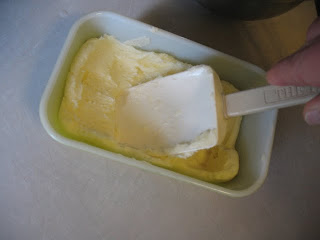
It’s so easy to make it’s ridiculous. Just shake it up and watch what happens. The below photos are from a batch I made last week. From cream to butter took about 10 minutes total time.


Starting to thicken up . . .

Just before it starts to separate; really thick here

Starts collapsing and clinging together . . .

And suddenly, you have pure butter and


Unworked butter (still needs residual buttermilk

Push the butter around for a minute or two until
Press into a mold . . .

New batch ready to stick into freezer. Once frozen,
Maybe it’s because we only use real butter in our house and a pound of it in the grocery store goes for around $3.50 these days (we almost never have to buy any since I've started making it).
Maybe it’s because it tastes better than store-bought butter and we know EXACTLY what’s in it and how it was made (not to mention who made it :-)
Or maybe it’s just because I like making it so much. Did I mention that I think it is SO ROCKIN’ COOL?
I know; I’m weird.
Every week I skim about a quart of cream from the milk I get from a local farm. Catherine uses a little bit of the cream to put in her coffee, and in the summertime we’ll put some to good use making homemade ice cream. The rest of the time, it’s butter.
It’s so easy to make it’s ridiculous. Just shake it up and watch what happens. The below photos are from a batch I made last week. From cream to butter took about 10 minutes total time.

Half a jar of cream (it will expand).

Starting to thicken up . . .

Just before it starts to separate; really thick here
and hard to shake, but only for a few seconds.

Starts collapsing and clinging together . . .

And suddenly, you have pure butter and
old fashioned buttermilk!

Pour it into a collander (I got this one for $1
at the dollar store) . . .

Unworked butter (still needs residual buttermilk
wicked out or it will have a slightly sour smell)

Push the butter around for a minute or two until
no more buttermilk squeezes out . . .

Press into a mold . . .

New batch ready to stick into freezer. Once frozen,
I'll remove from mold, cut in half, wrap, & put in
freezer until needed.
So Rockin' Cool.
Friday, March 12, 2010
Peak - a - Boo
Interesting to see this kind of article in the mainstream news:
Oil Production to Peak in 2014, Scientists Predict
More and more I see topics that used to be relegated only to conspiracy theorists showing up through more “credible” sources like the Wall Street Journal, AP, Reuters, etc.
I have no idea if the scientist’s predictions in this case are correct, but it would sure seem to me that regardless of the specific date, sooner or later we will reach that “peak oil” plateau. And just for the record, very few scientists seem to be proposing that it will be “later”.
Most people, when thinking about a contracting oil supply, tend to focus on rising gasoline prices. It's viewed more as an annoyance and a personal financial burden than anything else.
Rising gas prices would certainly be one effect, but they would only represent the very tip of a what is actually an extremely large iceberg.
Think about how you live your life now and compare it to what life was like just 100 years ago. (Do a little Googling into history for photographs & descriptions if you need to.) What you will see is that up until the beginning of the 1900’s, the way people lived didn’t really change all that much from one century to the next. There were improvements to be sure, but they were all generally very small and incremental.
And then suddenly, just a little more than a century ago . . . Boom. Everything changes, with incredible speed.
Our entire way of life today – from interchangeable parts and the industrial revolution, to plastics and electronics, to transportation, to food production, to heating, to manufacturing – is all based on oil. If it’s not made of petroleum it was made with petroleum and transported by petroleum.
It’s all possible because of oil. It is all completely dependant on oil. And if – or maybe more appropriately when – oil isn’t available anymore?
Well now. That's something to think about, isn't it?
Oil Production to Peak in 2014, Scientists Predict
More and more I see topics that used to be relegated only to conspiracy theorists showing up through more “credible” sources like the Wall Street Journal, AP, Reuters, etc.
I have no idea if the scientist’s predictions in this case are correct, but it would sure seem to me that regardless of the specific date, sooner or later we will reach that “peak oil” plateau. And just for the record, very few scientists seem to be proposing that it will be “later”.
Most people, when thinking about a contracting oil supply, tend to focus on rising gasoline prices. It's viewed more as an annoyance and a personal financial burden than anything else.
Rising gas prices would certainly be one effect, but they would only represent the very tip of a what is actually an extremely large iceberg.
Think about how you live your life now and compare it to what life was like just 100 years ago. (Do a little Googling into history for photographs & descriptions if you need to.) What you will see is that up until the beginning of the 1900’s, the way people lived didn’t really change all that much from one century to the next. There were improvements to be sure, but they were all generally very small and incremental.
And then suddenly, just a little more than a century ago . . . Boom. Everything changes, with incredible speed.
Our entire way of life today – from interchangeable parts and the industrial revolution, to plastics and electronics, to transportation, to food production, to heating, to manufacturing – is all based on oil. If it’s not made of petroleum it was made with petroleum and transported by petroleum.
It’s all possible because of oil. It is all completely dependant on oil. And if – or maybe more appropriately when – oil isn’t available anymore?
Well now. That's something to think about, isn't it?
Wednesday, March 10, 2010
Why I Believe in God: Part II - Pascal's Wager
(to read Part I click here)
Back in the late 1980’s my brother and I had an in-depth discussion in my sister’s kitchen one day. The topic: Did God exist or not? I must have been 23 or so, because I’m four years older than my brother and he was in college at the time.
It was not an antagonistic conversation, but it was most certainly a debate; I was making the case for the existence of God, while my brother – who was a philosophy student – was taking the opposite stance.
(Some might question at this point which “god” I’m referring to; there are, after all, more than a few to choose from. At this point, simply understanding God as a “higher power” (i.e., the antithesis of evolutionary doctrine) will suffice. Explaining why I believe in the Christian God of Abraham as opposed to others is another discussion entirely, though there is certainly a reason for that too.)
As we went back and forth, each presenting our “evidence” for or against the existence of God, I wound up stumbling upon (and verbalizing in my argument) a realization that I have never forgotten: There either is a God or there isn’t, and you either believe in Him or you don’t.
I’ve always thought of this in my mind as the “Four Outcomes”, because it lays the groundwork for understanding that there are only four possible paths – and therefore only four possible “outcomes” – that are open to us.
Outcome #1: God does NOT exist / You do NOT believe in God.
If you are an atheist, this would be the outcome that justifies your existence. The big “win”, if you will. You were right all along. But it’s an interesting “win” if you dig into it a little.
First of all, you would never even know that you were right. Upon your death, consciousness would abruptly end and you would simply cease to exist. No thoughts, no realizations, no “I told you so”. Certainly no parades or celebrations. You would never even know.
And before that, what kind of life would you have “knowing” that there is no God? “Knowing” that when someone that you love dies, that’s it for them; too bad, so sad, they’re simply gone? “Knowing” that you are completely alone, with no one to talk to, no one to listen, and no one to help? Your life is an accident, and it has absolutely no meaning or purpose whatsoever.
And hope? Hope in what? It’s just you. Hope for what? There is nothing else.
It’s important to know that if you are an atheist, this is the best case scenario for you. This is as good as it will ever get; your “value proposition” for denying God, if you will. And this is what you’re telling other people that they should want as well.
I don’t know about you, but that just doesn’t sound all that good to me, especially when you consider the alternative . . .
Outcome #2: God DOES exist / You do NOT believe in God.
I don’t think there needs to be a whole lot of elaboration here. As before, your life would be just as meaningless and hopeless as if God did not exist, only this time, the end of it would be very different.
You wouldn’t just “fade away” into nothingness at your death; instead, you would have thoughts, you would have realizations, and you would understand that you were terribly, terribly wrong.
Not a situation I wish upon anyone.
This was all pretty deep stuff for me back in my early twenties, and I’ve carried it around in the years since thinking that I was pretty wise for being able to lay it all out like that. But you know what they say about pride, and as you might imagine, I eventually wound up eating a couple slices of humble pie when I discovered several years ago that – big surprise – I was not the first person in the history of the world to unearth this concept.
Solomon wrote that there is nothing new under the sun, so it wasn’t really a big shock for me to find out that Blaise Pascal outlined the same thing in almost the exact same way back in the 1600’s (and undoubtedly so did many others before him). The concept is commonly known as “Pascal’s Wager”, and there are some very interesting viewpoints & discussions on it if you should choose to run it through a search engine.
And if you do read some of the commentary about Pascal’s Wager, you’ll eventually see (roughly) the same “fatal flaw” that my brother made to me over 20 years ago in my sister’s kitchen: You can’t just decide to believe in God the same way that you would make a business decision.
My brother was absolutely right. Belief is not something that you can turn on or off with the flick of a switch. But if that’s true, then why even mention this at all, whether you call it “Four Outcomes” or “Pascal’s Wager” or anything else?
In and of itself, Pascal’s Wager proves nothing. It’s not a foundation to build anything on. It won’t make you believe or disbelieve anything.
But for me it was incredibly important because it was the first time I realized what the “playing field” looked like, and I was able to understand with all clarity that there are not an infinite number of possibilities available to us.
There are only four: There either is a God or there isn’t, and you either believe in Him or you don’t.
Once I understood how simple the playing field was, the search for the truth became a whole lot easier.
Ask, and it will be given to you; seek, and you will find; knock, and it will be opened to you. – Matthew 7:7
Back in the late 1980’s my brother and I had an in-depth discussion in my sister’s kitchen one day. The topic: Did God exist or not? I must have been 23 or so, because I’m four years older than my brother and he was in college at the time.
It was not an antagonistic conversation, but it was most certainly a debate; I was making the case for the existence of God, while my brother – who was a philosophy student – was taking the opposite stance.
(Some might question at this point which “god” I’m referring to; there are, after all, more than a few to choose from. At this point, simply understanding God as a “higher power” (i.e., the antithesis of evolutionary doctrine) will suffice. Explaining why I believe in the Christian God of Abraham as opposed to others is another discussion entirely, though there is certainly a reason for that too.)
As we went back and forth, each presenting our “evidence” for or against the existence of God, I wound up stumbling upon (and verbalizing in my argument) a realization that I have never forgotten: There either is a God or there isn’t, and you either believe in Him or you don’t.
I’ve always thought of this in my mind as the “Four Outcomes”, because it lays the groundwork for understanding that there are only four possible paths – and therefore only four possible “outcomes” – that are open to us.
Outcome #1: God does NOT exist / You do NOT believe in God.
If you are an atheist, this would be the outcome that justifies your existence. The big “win”, if you will. You were right all along. But it’s an interesting “win” if you dig into it a little.
First of all, you would never even know that you were right. Upon your death, consciousness would abruptly end and you would simply cease to exist. No thoughts, no realizations, no “I told you so”. Certainly no parades or celebrations. You would never even know.
And before that, what kind of life would you have “knowing” that there is no God? “Knowing” that when someone that you love dies, that’s it for them; too bad, so sad, they’re simply gone? “Knowing” that you are completely alone, with no one to talk to, no one to listen, and no one to help? Your life is an accident, and it has absolutely no meaning or purpose whatsoever.
And hope? Hope in what? It’s just you. Hope for what? There is nothing else.
It’s important to know that if you are an atheist, this is the best case scenario for you. This is as good as it will ever get; your “value proposition” for denying God, if you will. And this is what you’re telling other people that they should want as well.
I don’t know about you, but that just doesn’t sound all that good to me, especially when you consider the alternative . . .
Outcome #2: God DOES exist / You do NOT believe in God.
I don’t think there needs to be a whole lot of elaboration here. As before, your life would be just as meaningless and hopeless as if God did not exist, only this time, the end of it would be very different.
You wouldn’t just “fade away” into nothingness at your death; instead, you would have thoughts, you would have realizations, and you would understand that you were terribly, terribly wrong.
Not a situation I wish upon anyone.
Outcome #3: God DOES exist / You DO believe in God.
Again, not a lot of elaboration is necessary. If you’ve ever been to church, you’ve heard the message: no more tears, no more pain, just an eternity in heaven.
Outcome #4: God does NOT exist / You DO believe in God.
This one is a little more interesting, and it is the scenario that a lot of atheists seem to get very upset about; that people would believe in a God that does not exist. How foolish and silly. But look a little closer.
Again, just as in the “best case” for an atheist, if God does not exist, I would never even know. I’ll go through my life believing in God, and then, when I die, I would simply cease to be. I’d never know that I was wrong.
But before then, what a difference! A life filled with meaning, purpose, and hope. Facing my own mortality without fear. “Knowing” that when someone I love dies it is not the end, and being able to hold that hope in my heart for the rest of my life. “Knowing” that I am not alone; that there is someone watching over me, listening to my pleas, and helping me when necessary.
“Knowing” that I am loved in this world.
I have to ask, even if it turns out that I’m deluding myself, so what? Why should that bother anyone?
What’s interesting to me too, is that this would be the worst case scenario for a Christian, and yet, it seems to me that it is a far better outcome than the best case scenario for an atheist.
And, of course, all of this assumes that I'm wrong, which I don't believe I am.
Again, not a lot of elaboration is necessary. If you’ve ever been to church, you’ve heard the message: no more tears, no more pain, just an eternity in heaven.
Outcome #4: God does NOT exist / You DO believe in God.
This one is a little more interesting, and it is the scenario that a lot of atheists seem to get very upset about; that people would believe in a God that does not exist. How foolish and silly. But look a little closer.
Again, just as in the “best case” for an atheist, if God does not exist, I would never even know. I’ll go through my life believing in God, and then, when I die, I would simply cease to be. I’d never know that I was wrong.
But before then, what a difference! A life filled with meaning, purpose, and hope. Facing my own mortality without fear. “Knowing” that when someone I love dies it is not the end, and being able to hold that hope in my heart for the rest of my life. “Knowing” that I am not alone; that there is someone watching over me, listening to my pleas, and helping me when necessary.
“Knowing” that I am loved in this world.
I have to ask, even if it turns out that I’m deluding myself, so what? Why should that bother anyone?
What’s interesting to me too, is that this would be the worst case scenario for a Christian, and yet, it seems to me that it is a far better outcome than the best case scenario for an atheist.
And, of course, all of this assumes that I'm wrong, which I don't believe I am.
This was all pretty deep stuff for me back in my early twenties, and I’ve carried it around in the years since thinking that I was pretty wise for being able to lay it all out like that. But you know what they say about pride, and as you might imagine, I eventually wound up eating a couple slices of humble pie when I discovered several years ago that – big surprise – I was not the first person in the history of the world to unearth this concept.
Solomon wrote that there is nothing new under the sun, so it wasn’t really a big shock for me to find out that Blaise Pascal outlined the same thing in almost the exact same way back in the 1600’s (and undoubtedly so did many others before him). The concept is commonly known as “Pascal’s Wager”, and there are some very interesting viewpoints & discussions on it if you should choose to run it through a search engine.
And if you do read some of the commentary about Pascal’s Wager, you’ll eventually see (roughly) the same “fatal flaw” that my brother made to me over 20 years ago in my sister’s kitchen: You can’t just decide to believe in God the same way that you would make a business decision.
My brother was absolutely right. Belief is not something that you can turn on or off with the flick of a switch. But if that’s true, then why even mention this at all, whether you call it “Four Outcomes” or “Pascal’s Wager” or anything else?
In and of itself, Pascal’s Wager proves nothing. It’s not a foundation to build anything on. It won’t make you believe or disbelieve anything.
But for me it was incredibly important because it was the first time I realized what the “playing field” looked like, and I was able to understand with all clarity that there are not an infinite number of possibilities available to us.
There are only four: There either is a God or there isn’t, and you either believe in Him or you don’t.
Once I understood how simple the playing field was, the search for the truth became a whole lot easier.
Ask, and it will be given to you; seek, and you will find; knock, and it will be opened to you. – Matthew 7:7
(to read Part III, click here)
Subscribe to:
Posts (Atom)


